3 Apr 01
The Purist is always against the use of patterns. I was always taught "play what you hear!" But let's face it, there are times a few lead patterns come in pretty handy! A jam session. A pick up gig. Any situation where you are called on to play a lead where you haven't had time to work one out.
So here are the "session guitarist's" best friends. Today we will discuss two primary patterns and the permutations that can be made from them. These are both fixed index finger patterns, meaning the index finger stays on the same fret. The advantage to keeping the fingers on the same frets are: 1) speed - 2) easy to locate the key - and 3) ease of staying in the key.
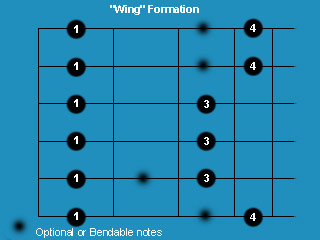
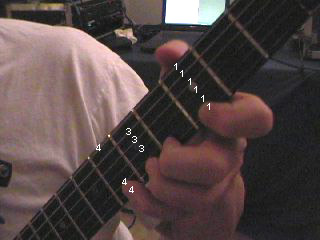
The "Wing Formation" Pattern
Since I love flying I tend to think of things in aviation terms. I've heard others call this the standard Pentatonic pattern as well, but when you look at it from above (and have a very creative mind) you can almost visualize 6 aircraft in wing formation:
The "Echelon Formation" Pattern
This is also a fixed index finger pattern, although it does NOT indicate the key. The index finger is placed one fifth above the minor key (7 frets) or 1 major 3rd above the major key (4 frets). For example, were you to play this pattern on the 10th fret (index finger E string playing a D), you would be in the key of G minor or B flat major (excellent pattern for playing Santana's Europa by the way).
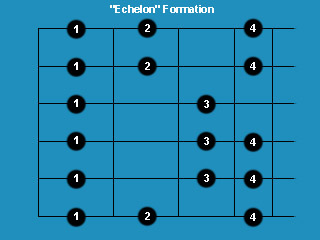
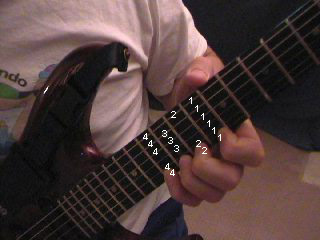
All the half steps are bendable, and I particularly like bending the "4" (pinky) on the B string up to the fifth.
As always, I am interested to hear your feedback. Please contact me with any sugesstions or comments!
Thanks,
John